
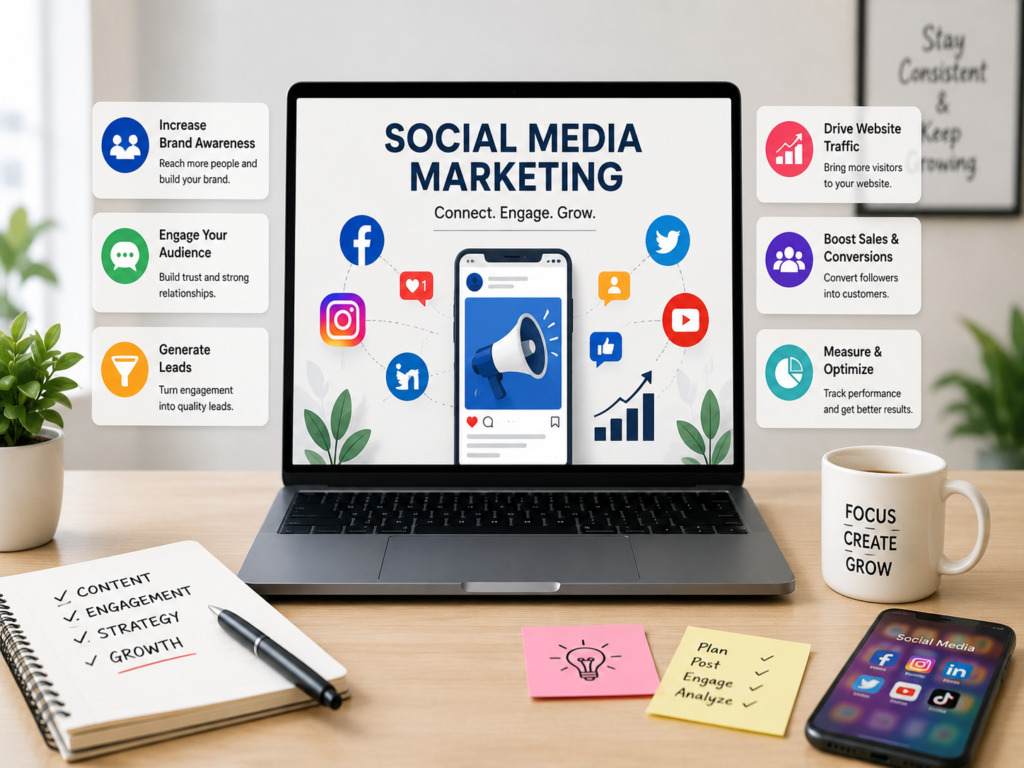
Social media marketing has become an important part of how small businesses connect with customers and grow their presence online. Platforms such as Facebook, Instagram, LinkedIn, and YouTube allow businesses to reach potential customers, communicate with their audience, and promote products or services effectively.
For small businesses, social media marketing can be particularly useful because it provides opportunities to build awareness and generate leads without relying only on large advertising budgets. With the right strategy, businesses can reach relevant audiences, share useful content, build relationships, and encourage potential customers to take action.
In this article, we will explore how social media marketing helps small businesses grow and how different social media strategies can contribute to long-term business growth.
What Is Social Media Marketing?
Social media marketing is the use of social media platforms to promote a business, communicate with customers, and achieve marketing objectives.
Businesses can use social media to publish informative content, showcase products or services, share business updates, interact with customers, generate leads, and drive visitors to their websites.
Social media marketing can include both organic activities and paid advertising. Organic marketing focuses on content and audience engagement, while paid social media advertising allows businesses to target specific groups of users based on factors such as location, interests, demographics, and online behaviour.
A combination of organic content and paid campaigns can help small businesses create a stronger and more consistent online presence.
Why Is Social Media Marketing Important for Small Businesses?
Small businesses often compete with larger companies that have established brands and bigger marketing budgets. Social media provides a way for smaller businesses to communicate directly with their target audience and build visibility in the market.
Instead of depending entirely on traditional advertising, a business can use social platforms to regularly share useful information and remain visible to potential customers.
Social media also creates two-way communication. Customers can comment, ask questions, send messages, and provide feedback. This interaction can help businesses better understand their audience while building stronger customer relationships.
When managed consistently, social media can become an important channel for awareness, engagement, website traffic, and lead generation.
How Social Media Marketing Helps Small Businesses Grow
Social media marketing helps small businesses at different stages of the customer journey. It can introduce a business to people who have never heard of it, educate potential customers about its products or services, and encourage interested users to visit the website or make an enquiry.
Regular content also gives businesses an opportunity to demonstrate their knowledge and communicate what makes their products or services valuable.
Over time, consistent visibility and useful communication can help a business build familiarity and trust with its audience. Paid advertising can further expand this reach by putting relevant offers in front of carefully selected audiences.
The result is a marketing channel that can support both customer acquisition and long-term brand development.
Build Brand Awareness
One of the biggest advantages of social media marketing is its ability to increase brand awareness.
When businesses regularly publish relevant content, more people can become familiar with their brand name, products, services, and expertise. Posts can also be shared by users, helping the business reach audiences beyond its existing followers.
For a small business that is still developing its market presence, this repeated exposure can be valuable. Potential customers may not make a purchase immediately, but recognising the brand later can influence their decision when they need the relevant product or service.
Consistent branding, useful content, and clear messaging can therefore help small businesses become more recognizable within their target market.
Reach the Right Target Audience
Social media platforms allow businesses to reach audiences based on characteristics that are relevant to their marketing goals.
Paid advertising campaigns can often be targeted using factors such as location, age, interests, behaviour, and other audience signals available on the platform.
For example, a local business may focus its advertising on people within a particular geographic area, while a B2B company may use platforms such as LinkedIn to reach professionals associated with relevant industries or job functions.
Better audience targeting can reduce unnecessary exposure and help businesses spend their advertising budget on people who are more likely to be interested in their products or services.
Generate Leads and Website Traffic
Social media can also help small businesses generate enquiries and bring potential customers to their websites.
Businesses can include links and clear calls to action in appropriate posts and advertisements, encouraging users to learn more about a service, visit a landing page, contact the business, or submit an enquiry.
Some advertising platforms also provide lead-generation formats that allow users to submit their information without leaving the social media platform.
However, generating a large number of leads should not be the only objective. Businesses should monitor lead quality, conversion rates, and actual business outcomes to understand whether their social media campaigns are attracting the right customers.
Build Trust and Customer Relationships
Customers often research businesses online before making a purchase or submitting an enquiry. An active social media presence can provide additional information about a company and demonstrate that the business regularly communicates with its audience.
Businesses can use social media to answer common questions, share educational information, highlight customer experiences where appropriate, and provide useful updates.
Responding professionally to comments and messages can also improve the customer experience.
Over time, these interactions can help businesses build stronger relationships with their audience and establish greater credibility online.
Use Content to Educate Potential Customers
Not every potential customer is immediately ready to buy. Some people first need to understand their problem, compare available solutions, and learn more about the product or service.
Social media gives businesses an opportunity to educate these audiences through useful content.
Depending on the business, this may include tips, short videos, guides, frequently asked questions, product demonstrations, industry information, or explanations of common customer problems.
Educational content can help potential customers make more informed decisions while positioning the business as a useful source of information.
Social Media Advertising for Small Businesses
Organic social media can help businesses build an audience, but organic reach alone may not always be enough to achieve consistent marketing results.
Paid social media advertising allows businesses to expand their reach and target audiences more precisely. Platforms such as Facebook, Instagram, and LinkedIn provide different campaign objectives depending on whether a business wants awareness, traffic, leads, engagement, or conversions.
Small businesses should start with clear objectives and carefully monitor campaign performance rather than simply increasing advertising spend.
Metrics such as cost per lead, conversion rate, customer acquisition cost, and return on advertising spend can provide a better understanding of whether campaigns are contributing to real business results.
Choosing the Right Social Media Platforms
A small business does not necessarily need to be active on every social media platform. The right platforms depend on the target audience, type of business, available resources, and marketing objectives.
Facebook and Instagram can be useful for many consumer-focused businesses because of their broad audiences and visual content formats. LinkedIn can be valuable for B2B companies that want to reach professionals and business decision-makers. YouTube can support businesses that benefit from tutorials, demonstrations, educational videos, or longer-form content.
The goal should be to focus on platforms where the target audience is most relevant rather than trying to maintain a presence everywhere.
Organic Social Media vs Paid Social Media
Organic and paid social media serve different purposes, and small businesses can benefit from using both strategically.
Organic social media is useful for publishing regular content, communicating with followers, building relationships, and maintaining an active brand presence.
Paid social media provides greater control over reach and audience targeting. It can help businesses promote specific offers, generate leads, drive website traffic, and reach people beyond their existing followers.
A balanced strategy can use organic content to build credibility and engagement while using paid campaigns to reach targeted audiences and support measurable business objectives.
How to Measure Social Media Marketing Results
Measuring performance is essential for understanding whether social media marketing is helping the business grow.
Metrics such as reach, impressions, engagement, clicks, and follower growth can provide useful information about audience activity. However, businesses should also connect social media performance with outcomes such as website enquiries, qualified leads, sales, and customer acquisition costs.
Website analytics and conversion tracking can help businesses understand what users do after clicking a social media post or advertisement.
By reviewing this data regularly, businesses can identify which platforms, campaigns, audiences, and content types are producing stronger results and adjust their strategy accordingly.
Common Social Media Marketing Mistakes to Avoid
One common mistake is publishing content without a clear objective or understanding of the target audience. Posting frequently does not automatically produce business growth if the content is not relevant to potential customers.
Businesses should also avoid focusing only on follower counts. A smaller but relevant audience can be more valuable than a large audience that has little interest in the company’s products or services.
Another mistake is running paid campaigns without proper conversion tracking. Without reliable data, it becomes difficult to determine whether advertising spend is generating meaningful results.
Consistency, relevant content, clear calls to action, accurate tracking, and regular optimization are more important than simply being active on multiple platforms.
Final Thoughts
Social media marketing can help small businesses grow by increasing brand awareness, reaching relevant audiences, generating website traffic and leads, and building stronger customer relationships.
The most effective approach is not simply to post more content or spend more money on advertising. Businesses need clear objectives, the right platforms, relevant content, accurate tracking, and continuous optimization.
When social media marketing is connected with other digital marketing activities such as SEO, paid advertising, website optimization, and analytics, it can become an important part of a broader growth strategy.
For small businesses, starting with a focused and measurable social media strategy can provide a strong foundation for building visibility, attracting potential customers, and supporting sustainable business growth.