What is digital marketing, and why has it become so important for businesses today? Digital marketing has changed the way businesses connect with their customers. Today, people use Google, websites, social media, and other online platforms to search for products, compare services, and make buying decisions. For businesses, having a strong digital presence is no longer optional—it plays an important role in reaching the right audience and staying competitive.
With the right digital marketing strategy, businesses can increase their online visibility, attract potential customers, generate qualified leads, and measure the results of their marketing efforts. Whether you run a small business or a growing company, digital marketing provides multiple opportunities to reach customers and grow your business online.
What Is Digital Marketing?
Understanding what is digital marketing and how it works can help businesses choose the right channels to reach potential customers.Digital marketing refers to the promotion of a business, product, or service using digital channels such as search engines, websites, social media platforms, email, and online advertising.
Unlike traditional marketing methods, digital marketing allows businesses to target specific audiences and track how people interact with their marketing campaigns. Businesses can measure website visits, ad clicks, enquiries, leads, conversions, and other important actions to understand their marketing performance.
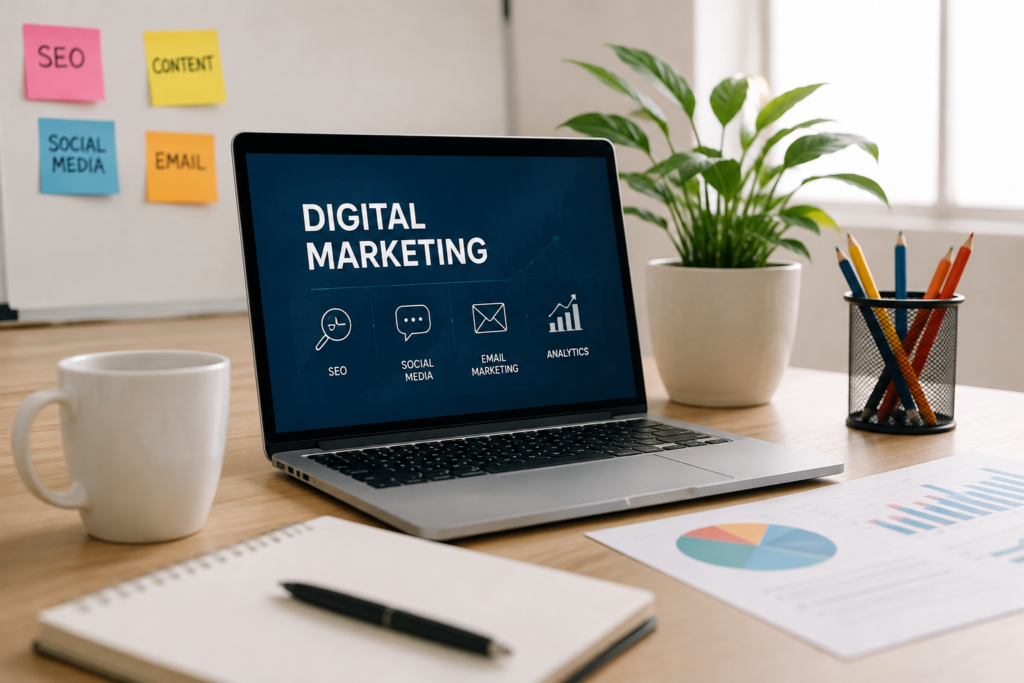
A complete digital marketing strategy can include several channels, such as SEO, Google Ads, social media marketing, content marketing, email marketing, and website optimization.
Why Is Digital Marketing Important for Businesses?
The way customers discover businesses has changed significantly. Before contacting a company or making a purchase, people often search online, read information about the business, compare different options, and check its digital presence.
If your business is not visible during this research process, potential customers may choose a competitor instead.
Digital marketing helps businesses establish a strong online presence and reach customers at different stages of their buying journey. It also gives businesses the flexibility to adjust their strategy based on customer behaviour and campaign performance.
For small and growing businesses, this is particularly valuable because marketing campaigns can be started with controlled budgets and scaled as results improve.
Key Benefits of Digital Marketing
Digital marketing provides businesses with greater control over how they reach potential customers and how their marketing budget is used.
Reach the Right Audience
Digital marketing allows businesses to target customers based on factors such as location, demographics, interests, online behaviour, search queries, and purchase intent.
Instead of promoting a business to a broad audience, companies can focus their marketing efforts on people who are more likely to be interested in their products or services.
Measure Marketing Performance
One of the biggest advantages of digital marketing is measurability.
Businesses can track important metrics such as website traffic, impressions, clicks, leads, conversions, cost per lead, and return on advertising spend. This data helps identify which campaigns and channels are generating results and where improvements are required.
Build Brand Visibility and Trust
Customers are more likely to remember and trust businesses they regularly encounter online.
Appearing in Google search results, publishing useful content, maintaining active social media profiles, and providing a professional website experience can strengthen brand credibility and keep a business visible throughout the customer journey.
Control Marketing Costs
Digital marketing provides greater flexibility over marketing budgets.
Businesses can decide how much they want to spend, monitor campaign performance, and increase or reduce budgets depending on the results. This makes it possible to allocate more resources to channels that generate better returns.
Generate Qualified Leads
Digital marketing is not only about increasing website traffic. A strong strategy focuses on attracting people who have a genuine interest in the products or services being offered.
Through relevant keywords, audience targeting, optimized landing pages, and clear calls to action, businesses can improve the quality of enquiries and generate more meaningful sales opportunities.
Main Types of Digital Marketing
Different digital marketing channels serve different purposes. Businesses usually achieve better results by combining multiple channels according to their goals, target audience, industry, and budget.
Search Engine Optimization, or SEO, is the process of improving a website so that it can appear more prominently in organic search engine results.
SEO includes keyword research, content optimization, technical improvements, website speed, mobile usability, internal linking, and building website authority.
A strong SEO strategy can help businesses generate consistent organic traffic from people actively searching for relevant products, services, or information.
Pay-Per-Click Advertising (PPC)
Pay-per-click advertising allows businesses to display paid advertisements to potential customers.
Google Ads, for example, can help businesses appear when users search for specific products or services. Advertisers can control their budget, select relevant keywords and audiences, and measure actions generated through their campaigns.
PPC can be particularly useful when a business wants immediate visibility, targeted traffic, or lead generation while building its long-term organic presence.
Social Media Marketing
Social media marketing uses platforms such as Facebook, Instagram, LinkedIn, and YouTube to connect with potential and existing customers.
Businesses can use social media to increase brand awareness, publish useful content, engage with audiences, generate leads, drive website traffic, and run targeted advertising campaigns.
The right platform depends on where the target audience spends its time and the type of product or service being promoted.
Content Marketing
Content marketing focuses on creating useful and relevant information that answers customer questions and helps them make informed decisions.
Blog articles, guides, videos, infographics, case studies, and educational resources are common forms of content marketing.
High-quality content can support SEO, establish expertise, build trust, and attract potential customers without relying entirely on paid advertising.
Email Marketing
Email marketing helps businesses communicate directly with prospects and existing customers.
It can be used to nurture leads, share useful information, promote products or services, announce offers, and maintain relationships with customers over time.
Personalized and relevant email communication can also help move potential customers further through the buying journey.
Website and Conversion Optimization
A website is often at the centre of a business’s digital marketing activities.
Generating traffic alone is not enough if visitors cannot easily understand the offer or take the next step. Website and conversion optimization focuses on improving page speed, mobile experience, navigation, landing pages, forms, calls to action, and overall user experience.
The objective is to convert more website visitors into enquiries, leads, or customers.
How Does Digital Marketing Help a Business Grow?
Understanding what is digital marketing and how different channels work together can help businesses build a more effective growth strategy.
SEO can attract users who are searching for information or solutions. Google Ads can capture high-intent searches and provide immediate visibility. Social media can introduce the brand to new audiences, while useful content can educate potential customers and build trust.
Once visitors reach the website, an optimized user experience and clear calls to action can encourage them to enquire or make a purchase.
Businesses can then use analytics and conversion data to understand which activities are contributing to actual business results and continuously improve their strategy.
Digital Marketing vs Traditional Marketing
Traditional marketing methods such as newspapers, magazines, radio, television, brochures, and outdoor advertising can still be useful depending on the target audience and business.
However, digital marketing provides additional advantages through precise targeting, measurable results, flexible budgets, and faster campaign optimization.
Instead of treating digital and traditional marketing as complete opposites, businesses should choose channels based on where their customers are and which methods can achieve their marketing objectives most effectively.
How to Choose the Right Digital Marketing Strategy
There is no single digital marketing strategy that works for every business.
Before selecting channels, businesses should clearly understand:
- Their marketing and business objectives
- Their ideal customers
- Where those customers search for information
- Their available marketing budget
- Their competitors
- Their website and landing-page experience
- How leads and conversions will be measured
For example, a business targeting people actively searching for a service may benefit from SEO and Google Ads. A visually driven consumer brand may place greater emphasis on social media, while a B2B company may combine search marketing, content, and LinkedIn.
The best strategy is one that connects marketing activities with measurable business outcomes.
Common Digital Marketing Mistakes to Avoid
Businesses sometimes invest in digital marketing without establishing a clear strategy or measurement system.
Common mistakes include targeting audiences that are too broad, focusing only on clicks or followers, ignoring conversion tracking, sending paid traffic to poorly designed landing pages, publishing content without understanding search intent, and changing campaigns before collecting enough data.
Digital marketing should be treated as an ongoing process of testing, measurement, learning, and optimization rather than a one-time activity.
Is Digital Marketing Suitable for Small Businesses?
Yes. Digital marketing can be particularly valuable for small businesses because it provides flexibility in both targeting and budget.
A small business does not necessarily need to compete with large companies across every marketing channel. Instead, it can focus on specific locations, customer segments, services, or search terms where it has the greatest opportunity to generate business.
Starting with clear objectives and a focused strategy can often be more effective than trying to use every available digital platform at once.
Start Growing Your Business with Digital Marketing
Now that you understand what is digital marketing, the next step is choosing the right channels and strategy for your business goals. Digital marketing gives businesses the opportunity to reach potential customers, measure marketing performance, and continuously improve how they generate leads and sales.
However, successful digital marketing requires more than simply running advertisements or posting on social media. It requires the right combination of strategy, audience targeting, content, technology, tracking, and ongoing optimization.
At Om Digihub, we help businesses build result-focused digital marketing strategies through SEO, performance marketing, social media marketing, and website development.
Ready to grow your business online? Contact Om Digihub to discuss a digital marketing strategy built around your business goals.